
November 25, 2025
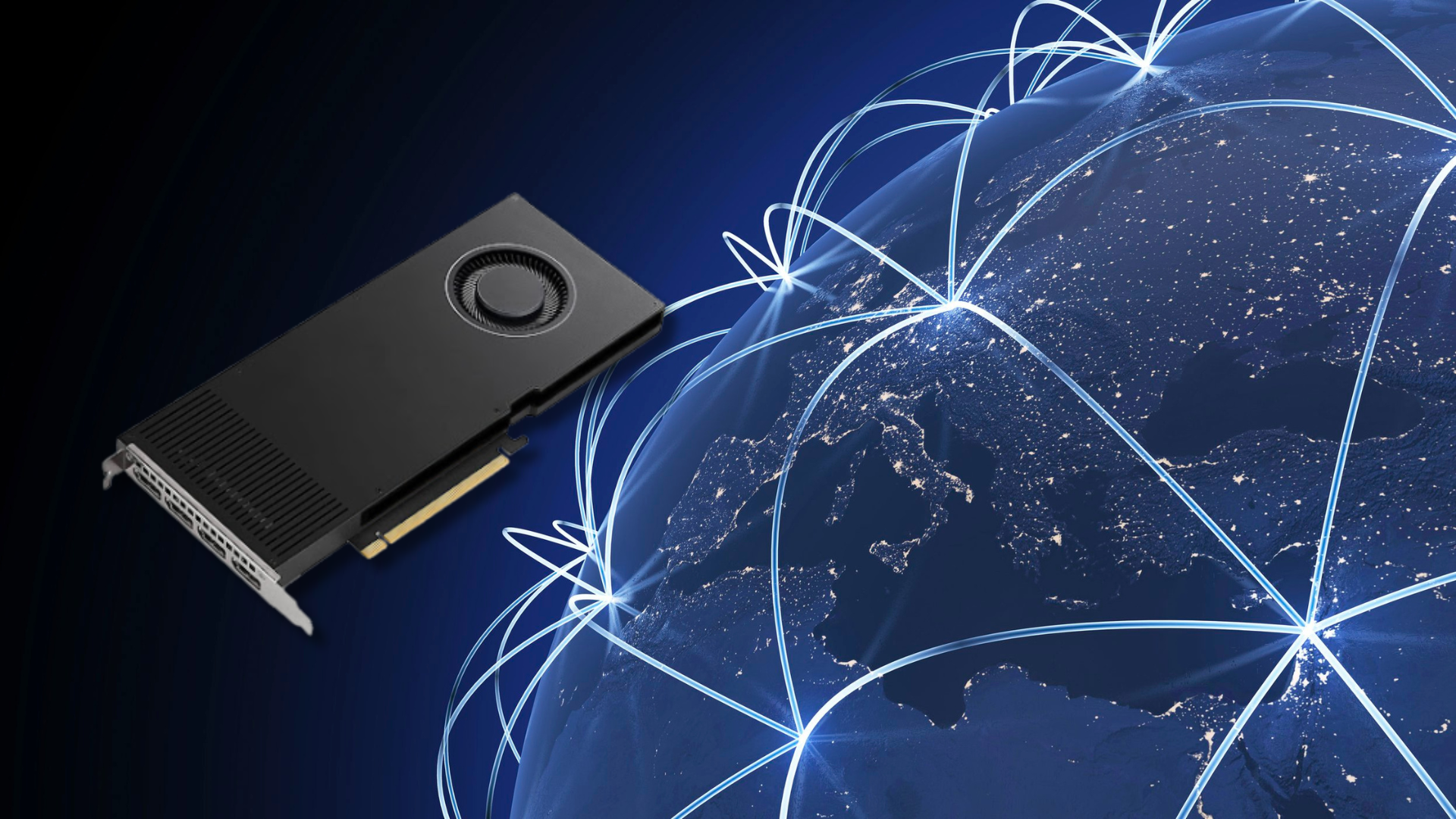
Transcoding sits at the core of every modern media workflow. Whether you’re preparing VOD libraries, powering live channels, or delivering multi-bitrate ladders for OTT platforms, everything depends on how efficiently you can ingest, process, and package video. For years, these workloads lived inside large on-prem encoder farms, designed for peak demand and maintained at high operational cost. But as codecs evolve and content volumes grow, that model has become increasingly limiting, and the industry is shifting toward cloud-based transcoding.
This transition is no longer a trend; it’s a response to the realities of modern media production. Teams need more elasticity, more processing headroom, and workflows that scale as quickly as content does. And with GPUs like the NVIDIA RTX 4000 Ada, cloud transcoding has not only become feasible, it has become the superior option for performance, efficiency, and long-term flexibility.
For years, on-prem transcoding systems made sense when workloads were predictable and codecs changed slowly. But today, media production and distribution are defined by unpredictability. Live events surge unexpectedly, ingest volumes spike overnight, and new OTT territories require customized output profiles. Maintaining an oversized hardware stack for occasional peaks is expensive and inefficient.
The cloud changes this dynamic entirely. Instead of building infrastructure for your highest load, you scale capacity up or down instantly based on real demand. That alone makes cloud transcoding far more economical. But what really drives this shift is agility: the ability to work with new codecs, new resolutions, and new delivery standards without waiting for hardware refresh cycles or procurement delays.
This is particularly critical as formats like AV1, 4K HDR, and high-density multi-profile encoding become mainstream, workloads that traditional CPU encoders struggle to handle.
Video transcoding is a deeply parallelized process. Each block of each frame can be processed independently, making GPUs the natural fit for the job. Unlike CPUs, which are optimized for sequential operations, GPUs excel at running thousands of simultaneous tasks. That difference translates into higher throughput, lower latency, and much more consistent performance.
The biggest benefit isn't just raw speed, it’s predictability. GPU-accelerated pipelines deliver stable, repeatable performance across both live and VOD workflows. When you’re processing 4K content, generating complex ABR ladders, or handling dozens of simultaneous streams, stability becomes just as important as speed.
The RTX 4000 Ada stands out as one of the most efficient GPUs for cloud-based video processing. Built on the Ada Lovelace architecture, it combines strong compute performance with next-generation hardware encoders and decoders, ideal for modern media workflows.
Here are the capabilities that make it so effective:
This combination of codec support, memory capacity, and efficiency makes the RTX 4000 Ada a perfect fit for cloud transcoding environments, especially when paired with infrastructure optimized specifically for media workloads.
Moving transcoding to the cloud is only the first step; choosing the right cloud infrastructure makes all the difference. 1Legion was built with media companies in mind, from broadcast vendors to OTT platforms and video SaaS providers.
Deploying the RTX 4000 Ada on 1Legion gives your transcoding pipeline the elasticity it always needed. You can spin up additional GPU nodes during major events, large ingest cycles, or content migrations, and deallocate them when the job is done. There’s no idle hardware sitting in a rack, and no waiting weeks for infrastructure procurement.
One of the biggest advantages is pricing transparency. Traditional cloud providers often bury transcoding-related costs under bandwidth charges, storage fees, or per-region premiums. For video-heavy workflows, these hidden costs add up quickly. 1Legion eliminates this uncertainty through predictable billing and unmetered bandwidth, a critical advantage for media companies that move terabytes of video every day.
Beyond cost, performance tuning matters. 1Legion’s GPU infrastructure is optimized end-to-end for real-time ingest, multi-profile generation, and smooth throughput during high-density workloads. Instead of adapting generic cloud servers for media, you deploy into an environment designed for video from the ground up.
And unlike hyperscalers, you’re not left alone to figure out configurations or troubleshoot under pressure. Real human support, engineers who understand transcoding, codecs, and GPU acceleration, is available through Slack and direct onboarding sessions.
Most teams begin their transition with hybrid workflows. They might offload certain VOD batches, regional playout variations, or specific codec pipelines to the cloud while keeping the rest on-prem. This minimizes risk while validating real performance and cost models.
Once confidence grows, scale becomes effortless. Additional RTX 4000 Ada GPUs can be deployed within minutes to handle heavy ingest days, archive restoration, 4K remaster projects, or large-scale live events. Over time, teams often adopt automation and container-based workflows, turning the cloud into a fully dynamic, intelligent transcoding engine.
The result is a pipeline that responds to the business instead of restricting it, scaling when necessary, staying cost-efficient when idle, and staying technically relevant as codecs evolve.
Cloud transcoding has become an essential evolution for media companies that need speed, scalability, and predictable costs. The NVIDIA RTX 4000 Ada delivers the codec support, efficiency, and multi-stream performance required for today’s complex video pipelines. And with 1Legion’s media-focused infrastructure, predictable pricing, unmetered bandwidth, rapid provisioning, and real human support, the transition feels seamless and future-proof.
If your team is ready to modernize its transcoding workflow, the cloud, and especially the RTX 4000 Ada on 1Legion, offers a powerful path forward. Contact our Engineers here.